

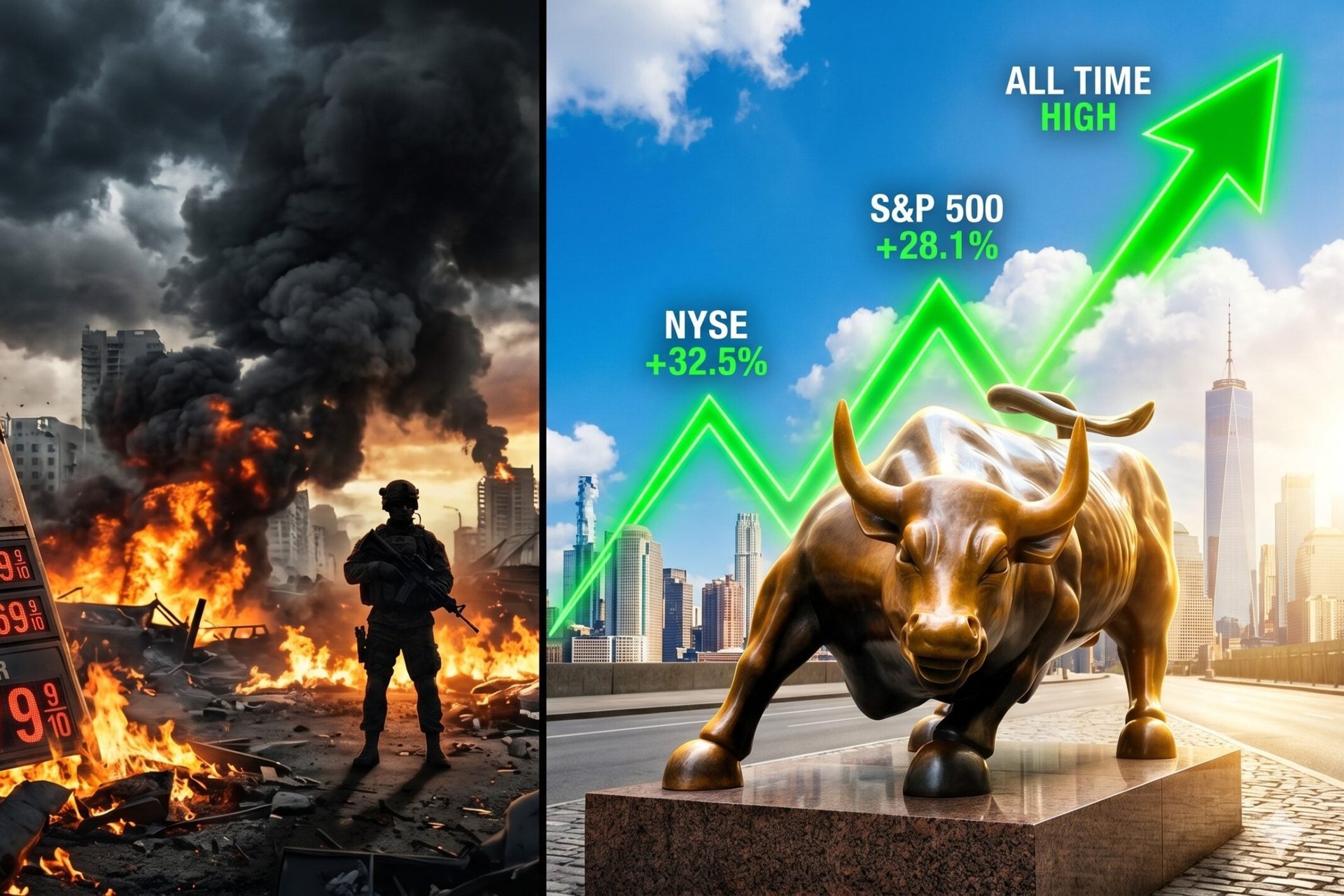
There’s a war in the Middle East. Gas just blew past $4 a gallon. Oil is flirting with $100 a barrel. The Strait of Hormuz — a chokepoint that handles roughly 20% of the world’s seaborne oil — has been opened, closed, and reopened like a revolving door.
And yet, on April 15, the S&P 500 crossed 7,000 for the first time in history. It’s hit multiple record highs since. The Nasdaq is at all-time highs too.
If you’re confused, you’re not alone. But if you’re panicking, you’re making a mistake. I’ve been watching markets for over 40 years — as a stockbroker, a CPA, and an investor — and I’ve seen this movie before. The world catches fire, and stocks go up. It happened in World War II. It happened after 9/11. And it’s happening now.
Here’s why.
1. Corporate America is making a fortune
This is the single biggest reason stocks keep climbing, and it’s the one most people overlook because they’re glued to war headlines.
S&P 500 companies are on track to report earnings growth of about 13% for the first quarter of 2026, according to FactSet. That’s the sixth straight quarter of double-digit earnings growth.
Let that sink in. Six quarters in a row.
Of the companies that have reported so far, 88% have beaten earnings estimates. That’s well above the five-year average of 78%. When companies make more money than expected, their stock prices go up. It isn’t complicated.
2. AI is printing money for tech companies
The information technology sector alone is expected to deliver around 45% earnings growth this quarter. That’s not a typo.
Companies like Nvidia and TSMC (Taiwan Semiconductor Manufacturing Company) aren’t just surviving — they’re thriving. TSMC reported a 58% jump in first-quarter profits and forecast full-year revenue growth of more than 30%. Tech stocks now make up nearly half the S&P 500’s market cap, so when they win, the whole index wins.
And here’s what’s changed: Tech stock valuations have actually come down. Price-to-earnings ratios in tech have compressed from around 32 to about 20, which means these stocks aren’t as overpriced as they were a year ago, even though they’re earning more. That gives investors more confidence to buy.
But there’s a flip side to that concentration. If you own an S&P 500 index fund, you might not be as diversified as you think.
3. Wall Street has seen this war movie before
I became an investment advisor in 1981. Since then, I’ve been invested through the Crash of ’87, the Gulf War, 9/11, the Iraq War, the Great Recession, the Russia-Ukraine conflict, and now the Iran war. You know what happened in nearly every one of those? Stocks dropped initially, then recovered — often quickly.
Here’s a fact that should keep you up at night if you sold in a panic: During World War II, the stock market bottomed in May 1942 — just months after the U.S. entered the war and before troops were even deployed in major theaters. From that low point, the Dow gained over 50% by the war’s end.
Research from the National Bureau of Economic Research has actually found that stock market volatility tends to be lower during wartime than peacetime. That sounds crazy, but it makes sense. Government spending becomes predictable, and earnings from defense contracts are easy to model.
If you sold your stocks when the Iran conflict started, you locked in a loss right before a massive rally. Before you make a move like that again, read this.
4. Investors are betting on a quick resolution
The market has a way of pricing in the future, not the present. And right now, most investors believe the Iran conflict will end sooner rather than later.
Tom Lee, head of research at Fundstrat, told CNBC the market has historically shown an ability to anticipate turning points even amid conflict. President Trump has told Fox Business that the war is “very close to over.” A ceasefire was announced on April 8, although how long it holds is anyone’s guess.
Now, that doesn’t mean things can’t go south. They absolutely can. Bank of America’s global economist cautioned that investors may be applying the “trade war playbook” — assuming Trump will de-escalate just like he did with tariffs last year. If that assumption is wrong, the market could face what Moody’s chief economist Mark Zandi calls a “full-blown correction,” which would be a decline of 10% or more.
But for now, the market is voting with its wallet. And it’s voting for peace.
5. Gas prices are high, but they’re already coming down
Yes, you’re paying more at the pump. The national average hit $4.11 in mid-April, according to AAA — the highest since 2022. That hurts, especially if you’re commuting to work or filling up an SUV.
But here’s what the market is seeing: gas prices already started dropping. They fell seven cents in one week to $4.04 after the ceasefire announcement, and as I write this are at $4.02. That trajectory matters more to stocks than the current price.
Remember, at the start of 2026, gas was under $3 a gallon. The spike was entirely driven by the Iran conflict. If the Strait of Hormuz stays open and tensions cool, prices could fall significantly. Energy Secretary Chris Wright told CNN that sub-$3 gas could return later this year or in 2027.
Markets are forward-looking. They’re already pricing in cheaper oil.
6. The rally isn’t just Big Tech anymore
One of the most bullish signs in this market? It isn’t just the mega-cap tech stocks driving things higher.
Smaller-company stocks have risen more than 60% from their April 2025 lows, according to U.S. Bank. The S&P 500 Equal Weight Index — which gives every company the same weighting instead of letting Apple and Nvidia dominate — is actually outperforming the regular S&P 500 this year.
When gains spread across many companies and sectors instead of being concentrated in a handful of names, it signals a healthier, more sustainable rally. That’s exactly what’s happening right now.
7. There’s no better alternative
This is the most underrated reason stocks keep going up: Where else are you going to put your money?
Bonds? The 10-year Treasury yield is hovering near 4.3%, but bonds and stocks have been moving in the same direction, which defeats the whole purpose of diversification.
Cash? You’ll earn a few percent, but inflation is running at 3.3%. You’re barely treading water.
Gold? It’s been on a tear, but it’s volatile and produces no income.
Stocks, for all their drama, remain the best long-term wealth builder on the planet. The S&P 500 has delivered an average annual return of about 10% over its history. That includes every war, recession, pandemic, and financial crisis thrown at it.
The bottom line
The world is messy. It always has been. And yet, over the long run, stocks go up. Not because investors are naive, but because companies adapt, innovate, and generate profits through every kind of chaos, although sometimes it takes time and nerves of steel.
I’ve been in this business long enough to tell you: the worst investment decision you can make is an emotional one. I’ve written about this before — the biggest reason most people don’t make money in the stock market isn’t the market. It’s themselves.
Don’t sell because the news is scary. Scary news is the norm, not the exception. Stay diversified. Stay invested. And if stocks are on sale because everyone else is running for the exits, that’s historically been the best time to buy — not sell.
If you need a game plan for riding out the next downturn, here’s what to do when your investments go down.
As I like to say: Unless you think the economy is going to zero, buy stocks when nobody else is. That’s how fortunes are made.
