


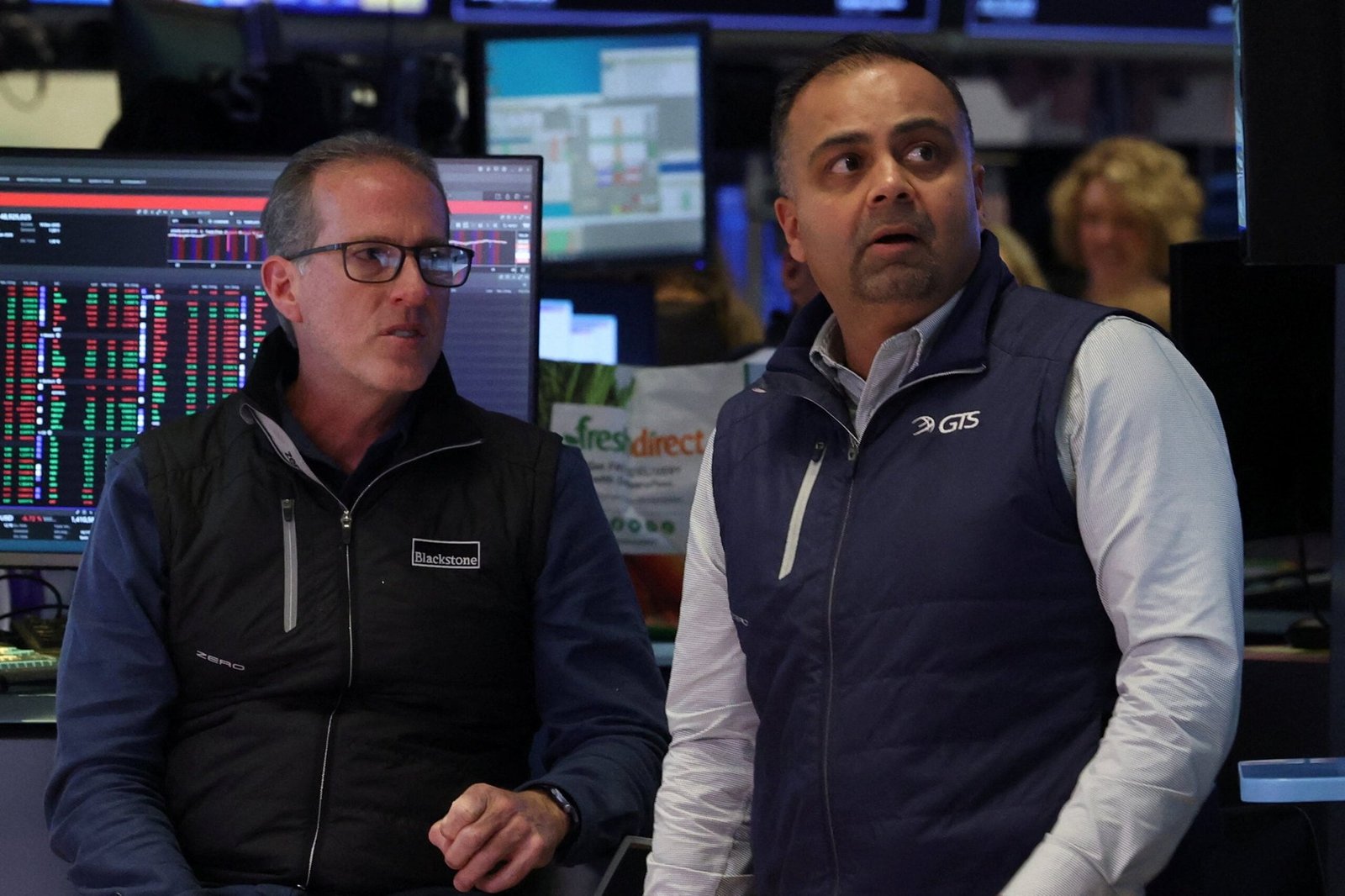
Global stocks were lower on Monday dragged down by losses on Wall Street and in European equities as fresh uncertainty over U.S. trade policy erupted following President Donald Trump’s new global tariff in the wake of a Supreme Court ruling.
The U.S. Supreme Court struck down Trump’s emergency tariffs on Friday, leading the president to quickly announce a new 10% rate on all U.S. imports, only to then lift it to 15% on Saturday. The new tariffs are based on Section 122 of the Trade Act of 1974.
The Dow Jones Industrial Average fell 1.44%, the S&P 500 fell 1% and the Nasdaq Composite fell 1.2%.
“We are giving up roughly half of Friday’s gain due mostly to the shift to 15% on Section 122 versus 10% announced Friday, reminding us that uncertainty remains high,” said Mark Hackett, chief market strategist at Nationwide in Philadelphia.
U.S. stock markets are also set to be tested later this week by earnings from Nvidia, which are likely to cause waves given that the chip designer makes up almost 8% of the S&P 500 index.
The pan-European STOXX 600 index fell 0.2%. Germany’s DAX lost 0.75% but Britain’s FTSE 100 was flat. MSCI’s gauge of stocks across the globe fell 0.63%.
Gold climbed 1.9% to $5,200 an ounce and silver rose 3% to around $87.36 per ounce.
U.S. Treasury yields were lower across the board. The yield on benchmark U.S. 10-year notes fell 2.7 basis points to 4.056%. The 2-year note yield fell 0.8 basis points to 3.472%.
Tariff dilemma
It was unclear when the new tariffs would be imposed, what might be excluded and whether every country would face a 15% rate. Some, including the UK and Australia, had 10% tariff rates under the former rules, while many countries in Asia had higher rates.
The Yale Budget Lab said the overall average effective tariff rate would stand at 13.7% after Trump’s announcement on Saturday, down from 16% – the highest since 1936 – before the Supreme Court’s ruling.
It added that it expected the 15% tariffs would expire after 150 days, following the Trade Act of 1974, under which they will be set. If so, the average rate would fall to 9.1%.
The U.S. dollar was weaker against the euro, Japanese yen and Swiss franc. The dollar fell 0.41% to 154.41 against the Japanese yen. Against the Swiss franc, the dollar weakened 0.27% to 0.774.
The euro was up 0.16% at $1.1799. The dollar index rose 0.23% to 97.60.
Brent crude oil prices rose 0.88% to $72.35 a barrel, adding to the gains made last week when Trump said the U.S. could strike Iran amid a large-scale buildup of forces in the region. Further U.S.-Iran talks are scheduled for Thursday.[O/R]
(Reporting by Chibuike Oguh in New York and Harry Robertson in London;Editing by Ros Russell)
